Physics A Level | Chapter 8: Electric current 8.1 Electric Circuit symbols and diagrams

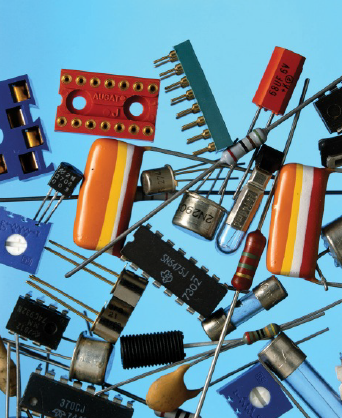
Before we go on to study electricity we need to introduce the concept of circuit diagrams. It is impossible to draw anything but the simplest circuits as a detailed drawing. To make it possible to draw complex circuits, a shorthand method using standard circuit symbols is used. You will have seen many circuit components and their symbols in your previous studies. Some are shown in Table 8.1 and Figure 8.4.
The symbols in Table 8.1 are a small part of a set of internationally agreed conventional symbols for electrical components. It is essential that scientists, engineers, manufacturers and others around the world use the same symbol for a particular component. In addition, many circuits are now designed by computers and these need a universal language in which to work and to present their results.
The International Electrotechnical Commission (IEC) is the body that establishes agreements on such things as electrical symbols, as well as safety standards, working practices and so on. The circuit symbols used here form part of an international standard known as IEC 60617. Because this is a shared ‘language’, there is less chance that misunderstandings will arise between people working in different organisations and different countries.
| Symbol | Component name |
|
|
connecting lead |
|
|
cell |
|
|
battery of cells |
|
|
fixed resistor |
|
|
power supply |
|
|
junction of conductors |
|
|
crossing conductors (no connection) |
|
|
filament lamp |
|
|
voltmeter |
|
|
ammeter |
|
|
switch |
|
|
variable resistor |
|
|
microphone |
|
|
loudspeaker |
|
|
fuse |
|
|
earth |
|
|
alternating signal |
|
|
capacitor |
|
|
thermistor |
|
|
light-dependent resistor (LDR) |
|
|
semiconductor diode |
|
|
light-emitting diode (LED) |


What’s in a word?
Electricity is a rather tricky word. In everyday life, its meaning may be rather vague – sometimes we use it to mean electric current; at other times, it may mean electrical energy or electrical power. In this chapter and the ones that follow, we will avoid using the word electricity and try to develop the correct usage of these more precise scientific terms.